


GDE-077 |
Vehicle registration checks | |||||||
Identity | ||||||||
October 2026 | ||||||||
01
What it is
A license plate lookup is a check of a vehicle's registration number against official and open records to confirm its make, colour, age and history. For an investigator, it tests whether the vehicle in a photo, video or report is the vehicle the plate belongs to.
A number plate is a claim printed on metal. A lookup turns it into a record you can compare with what the camera actually shows: the make, the colour, when the vehicle was first registered and whether it has been tested, taxed or flagged.
That answers practical questions. Does the car in the viral clip match its plate? Is the vehicle outside an address the one a source described? Could a plate have been cloned onto a different car? Verification desks, fraud investigators and researchers use these checks alongside geolocation and image dating.
| When to use this guide
|
02
How do you run a license plate lookup on a vehicle?
Five free tools and six steps take you from a plate in an image to a recorded verdict on whether the vehicle matches it.
All five tools are free to use. The first two cover vehicles registered in the United Kingdom; the VIN tools cover the United States; PlatesMania covers plates worldwide.
DVLA vehicle enquiry service: Free, no login. Enter a registration number to see the vehicle's make, colour, tax and MOT status, month of first registration, year of manufacture, engine size, fuel type and the date the latest log book was issued. It does not show keeper details.
Check MOT history: Free, no login. Shows past MOT results and the mileage recorded at each test for cars, motorcycles and vans tested since 2005, or since 2017 for tests in Northern Ireland. Seeing where a test in Great Britain was done needs the 11-digit number from the log book.
NHTSA VIN Decoder: Free, no login. Decodes the information a manufacturer encodes in a vehicle identification number (VIN), including the build plant and country, and accepts partial VINs. It rejects model years before 1981.
NICB VINCheck: Free, no login, limited to five searches per IP address in 24 hours. Shows whether participating US insurers have reported a vehicle stolen and not recovered, or as salvage. It does not query law enforcement records.
PlatesMania: Free to search; uploading photos needs registration. A crowdsourced gallery of more than 31 million plate photos that you can search by registration number and browse by country to learn plate formats.
| Before you begin Stop at the login. The DVLA, MOT, NHTSA and NICB services all work without an account. If a lookup site asks you to sign up or pay to reveal an owner's name, stop: that is not a lookup this guide relies on. Legal considerations. In Great Britain, keeper details come only from a written request to DVLA with reasonable cause, using form V888 for individuals. In the United States, the Driver's Privacy Protection Act limits how state motor vehicle agencies disclose personal information from their records. Where GDPR applies, treat a plate you link to a person as personal data. |
Archive the page where the image appeared, then write the plate down character by character. Note any you cannot read with certainty and list the alternatives, such as O and 0 or I and 1. Record the plate's colours, layout and any country band.
Compare the plate's layout with examples on PlatesMania for the candidate country. A current Great Britain plate has a two-letter memory tag, a two-digit age identifier and three random letters. The age identifier is the year for March to August registrations, and the year plus 50 from September to February.
For a Great Britain plate, enter the number in the DVLA vehicle enquiry service. Record the make, colour, month of first registration and year of manufacture, then compare each one with the vehicle in the image.
Run the same plate through Check MOT history. Note test dates, results and recorded mileage. A vehicle with recent passes is in use; a long gap, a failure pattern or a sudden mileage drop is worth a closer look.
A VIN is often visible through the windscreen or on documents. Run it through the NHTSA VIN Decoder to confirm the make, model year and build plant, then through NICB VINCheck for stolen or salvage reports. A clean NICB result is not a full history.
Search PlatesMania for the registration to find earlier photos of the same vehicle. Then write the verdict: which fields match, which do not, the sources checked and your confidence tier.
|

03
Where a license plate lookup can mislead you
Most errors come from trusting the plate more than the vehicle, or reading a vehicle record as something it is not.
Cloned plate read as the real vehicle: A plate copied from a similar car will return a clean, genuine record. The lookup confirms the plate exists, not that it belongs on the vehicle in front of you. Verifying check: match the make, model and colour from the record to the image, plus at least one detail such as wheels, trim or damage, before you call it a match.
Plate characters read as vehicle age: Personalised numbers can be moved between vehicles, and DVLA issues Q numbers to vehicles whose age or identity is in doubt. The characters on the plate may say nothing reliable about the vehicle. Verifying check: date the vehicle from the year of manufacture and month of first registration in the DVLA record, not from the plate.
Misread character taken as the right plate: Low-resolution or angled images make O and 0, I and 1, or B and 8 easy to confuse, and a near miss can return a real record for a different car. Verifying check: run every plausible variant and keep only the one whose record matches the vehicle you can see.
License plate lookup record read as the owner: The DVLA and MOT services describe the vehicle, not who keeps or drives it. Paid sites that promise an owner's name from a plate fall outside the lawful routes above. Verifying check: attribute a vehicle to a person only through lawful records or independent corroboration, and grade that link separately.
Chain of custody: A plate check has to be repeatable by an editor or a court. Vehicle records change as tax lapses, tests are taken and plates move, so the record you keep is what shows what each source said on the day you checked it.
Archive the page where the image or claim first appeared
Save the original image with the plate characters you read and any alternatives
Capture each lookup result with the date and time of the check
Record which fields matched the vehicle in the image and which did not
Log any VIN used and the NHTSA and NICB results
Write the verdict with its sources and confidence tier
04
Go deeper
One reference card and one Methods tutorial for placing the vehicle you have identified.
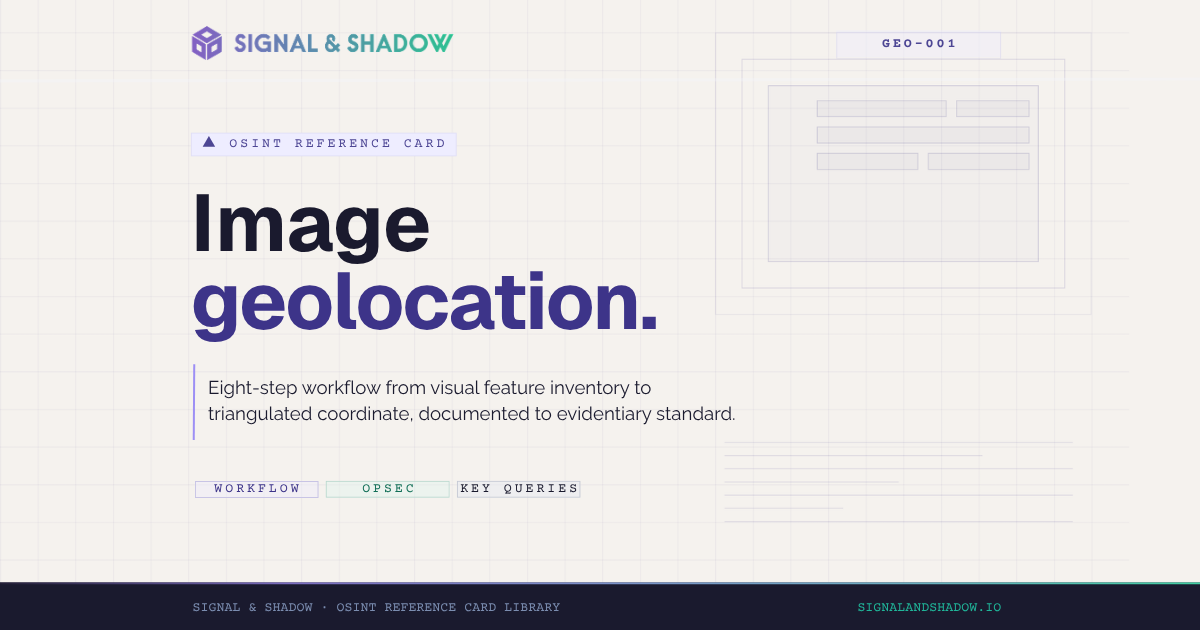
CARD · GEO-001
Image geolocation: methodology and workflow
Google Earth Pro, SunCalc and Mapillary, triangulated to a confirmed coordinate.
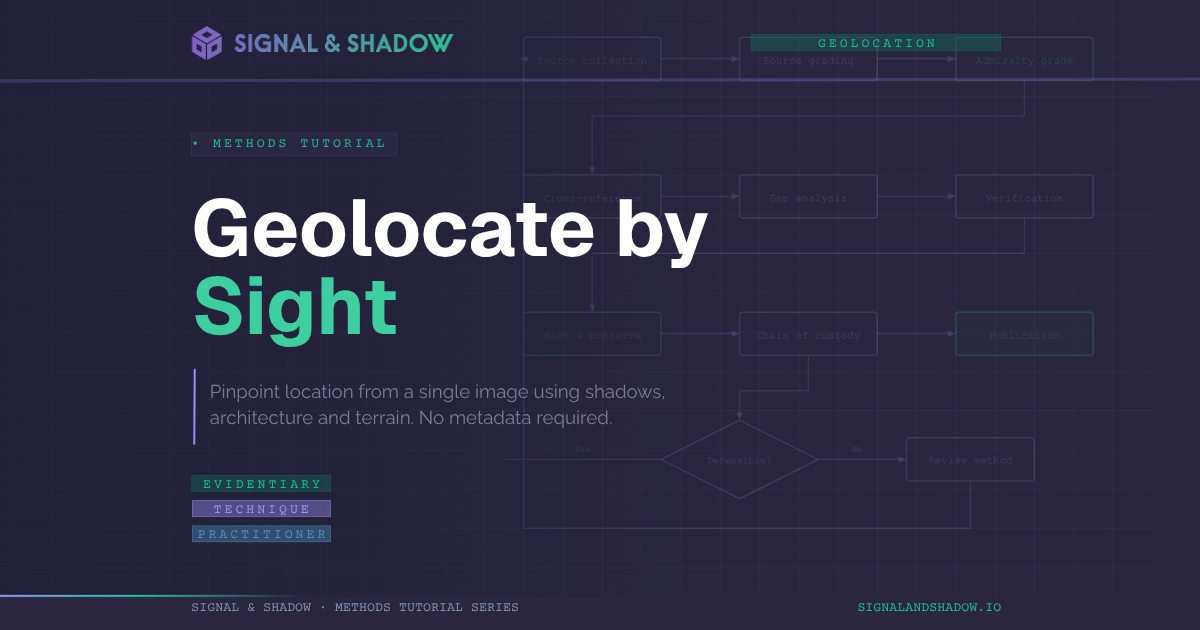
METHODS · SIGNAL TIER
Pinpointing location through visual clues: shadows, architecture and terrain
Sun-shadow analysis, vernacular architecture and terrain reading, narrowed from country to street.
Evidentiary standard
Signal & Shadow operates to the LST-001 evidentiary standard. All claims are graded against the LST-001 v1.0.3 confidence tiers (Confirmed, Corroborated, Reported, Alleged) per the canonical voice and structural specification.
About Signal & Shadow
Signal & Shadow is an independent forensic investigation and methodology practice publishing tutorials, reference cards, and forensic dossiers for working practitioners. Founded by Derek Bowler.